October has arrived with a problem that most gamers probably do not mind having: there are too many major games competing for attention at once.
The final months of 2026 are turning into an unusually crowded period for the industry. Large franchises are returning, long-awaited projects are finally reaching players, older games are being rebuilt for newer hardware, and publishers are placing some of their most commercially important releases into the same stretch of the calendar.
That makes October more than another busy month of releases. It offers a snapshot of where the games industry is heading.
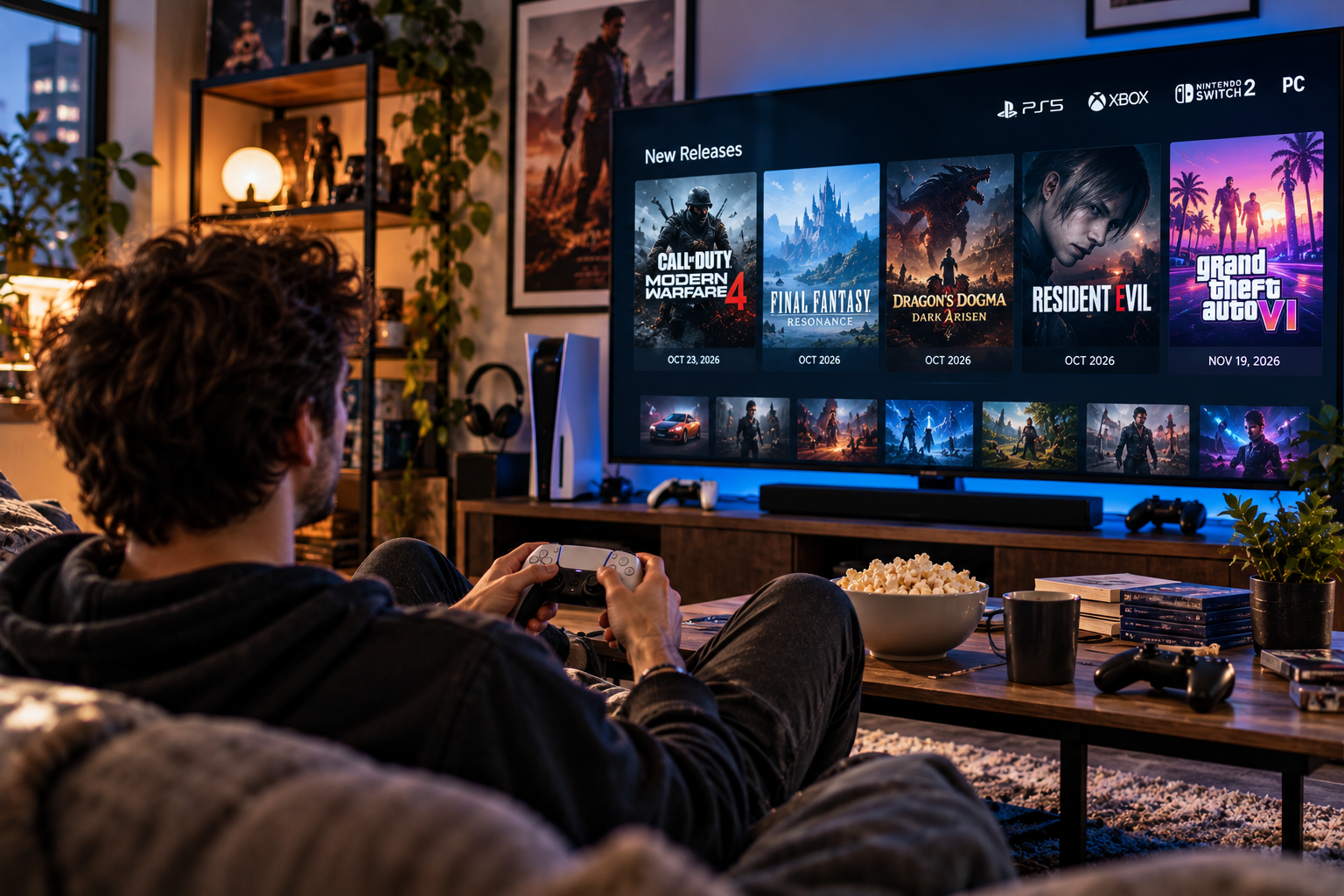
The current schedule brings together established franchises, new intellectual properties, remasters, platform-specific launches and major cross-platform releases. Meanwhile, the arrival of Grand Theft Auto VI is approaching in November, giving the entire autumn season an unusually high level of commercial pressure. Rockstar currently lists November 19, 2026 as the release date for GTA VI on PlayStation 5 and Xbox Series X|S.
The result is a gaming market in which the biggest question is no longer whether there are enough games to play. It is which games can still capture attention when almost everyone is competing for it at the same time.
October Has Become a Major Release Window
For years, the autumn period has been important to publishers. Holiday spending, new hardware cycles and the return of players after the summer months have traditionally made the second half of the year particularly valuable.
In 2026, however, the concentration of major releases is especially striking.
The current October calendar includes titles ranging from large-scale action games and shooters to RPGs, remasters, horror projects and experimental releases. VGC’s updated schedule describes the final quarter as one of the busiest periods of the year, with major releases spread across PlayStation 5, Xbox Series X|S, Nintendo Switch 2 and PC.
That variety is important because the modern games market is no longer dominated by a single type of blockbuster.
A major shooter can launch alongside a role-playing game, a remaster can compete with a new intellectual property, and an indie project can attract attention from the same audience through digital storefronts and social platforms.
October therefore becomes less like a traditional release window and more like a crowded media season.
Call of Duty Is Returning to the Centre of the Calendar
One of the biggest releases of the month is Call of Duty: Modern Warfare 4, which is scheduled for October 23.
The new instalment is being positioned as a major cross-platform release, arriving on PlayStation 5, Xbox Series X|S, PC and Nintendo Switch 2. The official Call of Duty site highlights campaign, multiplayer and DMZ content as central components of the release.
The Nintendo version is particularly notable.
Nintendo’s official October schedule confirms that Modern Warfare 4 is coming to Switch 2, alongside a range of other major releases.
That illustrates a broader change in the console market. High-profile third-party games increasingly have to consider more than one hardware ecosystem, while newer platforms are trying to establish themselves as places where major franchises can exist rather than as secondary destinations for smaller releases.
For players, this creates more choice. For publishers, it creates a much more complicated launch strategy.
A major game now has to perform across different hardware specifications, storefronts, online communities and platform policies while maintaining a consistent identity.
Switch 2 Is Building a Bigger Third-Party Library
Nintendo’s October schedule reveals another important development: Switch 2 is increasingly being treated as part of the wider release conversation.
The platform’s October lineup includes Kingdom Hearts Collection [I–III], Dragon’s Dogma 2: Dark Arisen, several Resident Evil releases, Final Fantasy Resonance, Modern Warfare 4 and an enhanced version of Minecraft.
The significance goes beyond the individual games.
Nintendo has historically maintained a distinctive software ecosystem, but the arrival of more technically ambitious third-party titles on its newer hardware gives players a different relationship with the platform.
Instead of choosing between a Nintendo system and another gaming device because certain major franchises are unavailable, players increasingly have opportunities to find both traditional Nintendo experiences and large third-party productions in the same ecosystem.
That could become one of the defining characteristics of the current console generation.
The question is no longer simply which platform has the most exclusive games. It is which platform can offer the most attractive combination of first-party identity, third-party access, portability and technical performance.
PlayStation and Xbox Are Competing for the Same Attention
The competition is equally visible elsewhere.
PlayStation’s October lineup includes Modern Warfare 4 and Phantom Blade Zero among its highlighted releases, while Xbox is pushing major releases through both its console ecosystem and Game Pass. Microsoft’s Xbox Wire, for example, lists Gears of War: E-Day as an October 6 release with Game Pass and Xbox Play Anywhere support.
This demonstrates how the definition of a console release has changed.
A game is no longer necessarily tied to a single box under the television.
It can exist simultaneously across console hardware, PC storefronts and subscription services. Save systems, cross-platform multiplayer and digital distribution can make the boundaries between individual ecosystems less visible to players.
For publishers, however, those boundaries remain strategically important.
Every release has to answer several questions at once: where should the game launch, how should it be monetised, whether should it enter a subscription service, and how can the publisher keep players engaged after the initial purchase?
The modern launch is therefore becoming a business strategy rather than simply a release date.
GTA VI Is Waiting Just Beyond October
The biggest shadow over the autumn calendar belongs to a game that is not even launching in October.
Rockstar currently lists Grand Theft Auto VI for November 19, 2026. The game is confirmed for PlayStation 5 and Xbox Series X|S, with Rockstar continuing to position Vice City and the wider state of Leonida as the setting for the new story.
That date changes the meaning of everything released before it.
Publishers launching games in October are not simply competing with each other. They are also competing for consumer time before one of the most anticipated releases in the history of the medium arrives.
This creates an unusual situation.
A game can be successful in October and still face a difficult second half of the year because players may reduce their spending or simply run out of time once GTA VI arrives.
The competitive problem is therefore not only financial.
It is attention.
A player has a limited number of hours available each week. Even a successful game needs to convince that player that it deserves those hours.
The Industry Is Learning That Release Density Has Consequences
The crowded calendar also raises a question about how publishers decide when to launch games.
The traditional strategy of concentrating major titles around the holiday season made sense when physical retail and annual purchasing cycles played a larger role. Digital distribution has changed the mechanics of the market, but publishers still frequently cluster their biggest projects around periods when consumer spending is expected to be strongest.
The result can be a strange contradiction.
The industry can have an impressive number of games available while individual releases struggle to maintain visibility.
A game can receive strong reviews, attract a large audience during launch week and still disappear quickly from the public conversation because another major release arrives days later.
This is particularly important for games built around long-term engagement.
Multiplayer titles, live-service projects and expansive RPGs need time to develop communities. When several major games launch close together, players have to divide their attention between them.
That can make the first weeks after release more important than ever.
Remasters Are Becoming Part of the Mainstream Release Strategy
Another feature of the 2026 calendar is the continued importance of remasters and upgraded versions.
October includes Dynasty Warriors 3: Complete Edition Remastered and multiple older Resident Evil titles arriving on Nintendo Switch 2.
Remasters are no longer simply a way of putting an old game back on sale.
They can serve several purposes at once.
For publishers, they offer the opportunity to introduce established properties to new hardware and new audiences. For players, they provide access to older games without requiring legacy hardware. For platform holders, they strengthen software libraries during periods when entirely new productions may take years to complete.
The growing presence of remasters also reflects a broader reality of modern game development: creating major games has become expensive and time-consuming.
An established intellectual property carries a different level of market recognition from a completely unknown project.
That makes the past increasingly valuable to the present.
The Business of Gaming Is Becoming More Global
The current release calendar also demonstrates how international the games business has become.
A single major release can involve developers in multiple countries, global publishers, international esports communities, worldwide digital distribution and simultaneous launches across several platforms.
The audience is no longer organised primarily around local retail markets.
Digital storefronts allow games to become global products almost immediately. A successful release can build communities across continents within hours, while social media can turn a launch into an international cultural event.
This creates opportunities for smaller studios as well.
A game does not necessarily need the marketing resources of the largest publishers to reach a global audience. Visibility remains difficult, but digital distribution has reduced some of the traditional barriers between developers and players.
The challenge has shifted from access to discoverability.
There are now so many games available that being seen can be almost as difficult as being released.
What October Says About the Future of Gaming
The most interesting part of the current gaming calendar is not any single title.
It is the structure behind the releases.
Games are arriving across more platforms. Subscription services are becoming part of launch strategies. Remasters are extending the commercial life of established franchises. New hardware is expanding compatibility. Major publishers are competing not just over sales but over the limited amount of time players can dedicate to their games.
At the same time, the industry remains under considerable pressure.
Recent reporting continues to document layoffs, restructurings and studio closures across the games business, showing that a busy release calendar does not automatically translate into stability for developers. Game Developer’s current industry tracker includes recent reports involving Ninja Theory, Undead Labs, Nerial and other studios.
That contrast is one of the defining stories of gaming in 2026.
Players see an enormous flow of new experiences. Behind those releases, studios are dealing with rising production costs, changing business models and increasingly difficult decisions about which projects can justify years of development.
The Biggest Competition May Be for Players’ Time
October 2026 shows just how crowded the modern games market has become.
There are major franchises, upgraded classics, new platforms and long-awaited releases all fighting for space in the same cultural conversation. And with GTA VI scheduled for November, the intensity is unlikely to disappear as the year moves toward its final weeks.
For players, that abundance is exciting.
For the industry, it is a test.
The games that stand out will not necessarily be the ones with the largest budgets or the loudest marketing campaigns. They will be the ones that give players a compelling reason to stop scrolling, start playing and keep coming back.
That may be the real story of gaming’s current era: the industry has never had more ways to create, distribute and promote games, but the one resource no publisher can manufacture is still the same.
A player’s time.