For decades, the first question a player faced before buying a game was simple: which platform do you own?
That question is becoming less important.
In 2026, a growing part of the games industry is being built around a different idea. Players increasingly expect their library, progress, purchases and communities to follow them between devices. A game might begin on a console, continue on a PC and later be played on a handheld without feeling like three separate products.
The shift is happening at the same time as the PC market is showing remarkable strength. Independent estimates from Alinea Analytics put Steam revenue at about $1.7 billion for September 2026, 13% above the previous September record, with estimated revenue for the first nine months of the year reaching $16.5 billion. Alinea projects that Steam could exceed $20 billion for the full year.
These figures are estimates rather than financial results published by Valve, but they point to a significant change in the balance of the gaming market.
The traditional console-versus-PC debate increasingly misses what is actually happening. The future of gaming is becoming less about choosing one machine and more about choosing an ecosystem.
Steam’s Growth Shows That PC Gaming Is Far From Saturated
The continued strength of Steam is one of the clearest signs that PC gaming remains central to the industry.
September 2026 was reportedly Steam’s strongest September ever. The estimated $1.7 billion in monthly revenue came despite increasingly expensive PC hardware, suggesting that players are still willing to spend on games even when the cost of building or upgrading a gaming computer is under pressure.
The interesting part is where that money is coming from.
The PC market does not depend entirely on a handful of annual blockbusters. Established franchises, remasters, free-to-play games, early-access projects and completely new intellectual properties can all find audiences on the same storefront.
September provided examples of this variety. Alinea’s analysis, reported by PC Gamer, estimated that Wardogs generated $86.9 million during the month, while Helldivers 2 and Arc Raiders also produced substantial revenue.
That makes the PC market unusually flexible.
A player can buy a $70 blockbuster, return to a five-year-old game, experiment with a small independent title or spend nothing on a free-to-play game and still remain inside the same ecosystem.
The storefront has become less like a traditional shop and more like a permanent gaming environment.
The Library Is Becoming More Important Than the Hardware
The next stage of platform competition is increasingly focused on libraries.
Microsoft has been particularly explicit about this direction. Its Xbox Play Anywhere program allows supported games to work across Xbox consoles and Windows PCs using a single purchase, while cloud saves and cross-progression allow players to continue their progress across supported devices. Microsoft also describes Play Anywhere as a way to reach players across PC, console and supported handheld hardware.
That changes the value of ownership.
In the traditional console model, buying a game meant buying access to a particular version for a particular machine. Moving to another platform could mean purchasing the game again, starting over or losing access to some features.
A connected ecosystem makes the hardware less central.
The player still needs a device, of course. But the device becomes an access point to the library rather than the defining location of the library itself.
This is an important psychological change.
A person may no longer think, “I am a console player.”
They may simply think, “These are my games.”
Handhelds Are Accelerating the Change
The growth of gaming handhelds is making the convergence even more visible.
Portable PC gaming has already demonstrated that a traditional desktop library can be moved into a smaller form factor. In 2026, Microsoft has also been extending Xbox functionality to PC handhelds. Its Xbox Backward Compatibility on PC initiative allows selected classic Xbox games to run on PC and supported handheld devices, with digital licenses carrying across through the Xbox ecosystem.
The significance is larger than a handful of older games.
Handhelds are becoming another screen through which players can access established libraries.
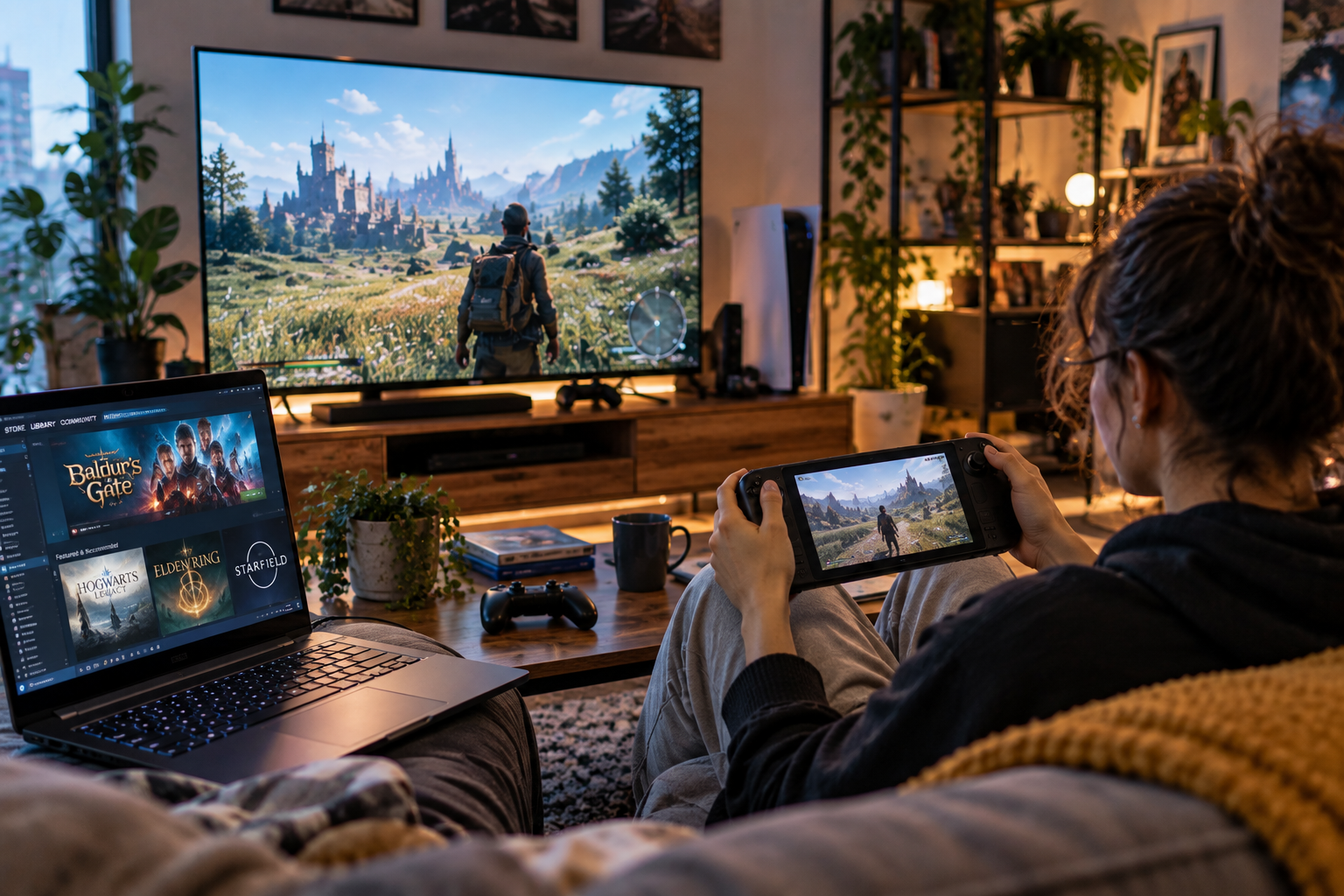
That creates a new relationship between home and portable gaming. A player can begin a long RPG at home, continue it on a handheld and later return to a desktop without treating those sessions as separate experiences.
The more seamless that process becomes, the less important the physical location of the game becomes.
For publishers, this creates an opportunity to sell one product into several different patterns of use.
For players, it can make expensive games more attractive because their usefulness is no longer limited to one device.
Cloud Gaming Pushes the Same Idea Further
Cloud gaming takes platform convergence one step further.
Instead of moving the game between devices, cloud services move much of the processing away from the player’s device altogether.
The Boston Consulting Group’s 2026 gaming report describes cloud gaming as one of the forces pushing the industry toward a more hardware-agnostic future. Its survey found that 60% of players had tried cloud gaming and 80% of those players reported a positive experience. BCG projects that global cloud-gaming revenue could grow from roughly $1.4 billion in 2025 to around $18.3 billion in 2030.
The technology still has limitations.
Internet quality, latency, image compression and service availability remain important. Many players who have tried cloud gaming continue to spend most of their gaming time on locally installed games.
But the direction is significant.
Cloud gaming does not need to replace consoles or PCs to change the market. It only needs to make certain gaming experiences easier to access.
A player who wants to try a game for a few minutes may be less willing to wait for a large download. Someone using a weaker laptop may still want access to a demanding title. A handheld user may want to continue a game without installing a massive package locally.
Cloud technology can reduce that friction.
The Old Console War Is Becoming an Ecosystem Competition
For years, the games industry was frequently described through the rivalry between Sony, Microsoft and Nintendo.
That competition has not disappeared.
But the battlefield is changing.
BCG argues that the boundaries between console, PC and mobile are becoming less important as players move between devices and as games become increasingly multiplatform. The report describes a future in which competition shifts from individual pieces of hardware toward broader ecosystems and cloud-enabled services.
Microsoft’s strategy is one visible example.
Xbox is no longer defined only by the console sitting beneath a television. Its ecosystem includes Windows PCs, cloud gaming and supported handheld devices. Play Anywhere reinforces the idea that a game can belong to an ecosystem rather than to a single piece of hardware.
Sony has been moving in a related direction through cloud streaming and PC releases, while Nintendo continues to develop its own hardware-led ecosystem.
The strategies are different, but the broader market is moving in the same direction: players are increasingly valuable because of their relationship with an ecosystem, not simply because they own a particular device.
Cross-Progression Is Becoming a Basic Expectation
One of the less visible technologies behind this shift is cross-progression.
For years, players accepted that changing platforms could mean starting again. That expectation is gradually disappearing.
Modern players increasingly assume that a game should remember them.
Their characters, achievements, purchased content, friends and progress can become part of an account rather than being permanently tied to a machine.
Microsoft’s Play Anywhere framework explicitly supports cloud saves and cross-progression between Xbox and PC, while its developer documentation describes continuity across screens as a way to reduce player churn.
This is not simply a convenience feature.
It changes how games are designed.
When developers know that players may move between several devices, interface design, save systems, graphics settings and performance profiles have to accommodate different environments.
A successful game ecosystem therefore needs to be flexible without feeling fragmented.
Developers Have More Platforms — and More Problems
For developers, platform convergence is not automatically easier.
Supporting multiple devices can increase the potential audience, but it also creates additional technical requirements.
A game designed for a high-end PC has to deal with very different performance conditions from a handheld. A console version may require different interface decisions from a desktop version. Cloud streaming introduces another layer of technical dependency.
The development team has to decide how much variation the game can support without weakening the core experience.
At the same time, multiplatform development can reduce dependence on a single storefront.
A studio that can reach players across PC, consoles and handhelds has more opportunities to build a sustainable audience. This becomes particularly important as development budgets rise and publishers need to recover costs from larger potential markets.
The financial argument for multiplatform development is therefore becoming difficult to ignore.
More Choice Also Means More Competition for Attention
There is a paradox at the centre of platform convergence.
Players have more freedom than ever, but developers face a harder fight to be noticed.
When games were tied to separate hardware platforms, each ecosystem created a relatively defined audience. Today, digital storefronts are enormous and increasingly interconnected.
BCG describes discoverability as one of the major challenges of the new gaming environment. As digital shelf space becomes effectively unlimited and more games appear across platforms, simply being available is no longer enough.
The September Steam figures illustrate the scale of that problem.
Strong revenue does not mean every game succeeds. A platform can generate billions of dollars while thousands of individual releases struggle to find sustained visibility.
This makes communities, creators, social media, recommendations and platform algorithms increasingly important.
The future gaming platform is therefore not only a technical system.
It is also a discovery system.
Subscription Services Are Changing the Meaning of a Sale
The shift toward ecosystems is also changing how players pay.
Subscription services such as Xbox Game Pass and PlayStation Plus have introduced a model in which the relationship between player and game is less dependent on a single purchase.
BCG identifies subscriptions alongside cloud gaming and other emerging distribution models as part of the industry’s transition toward engagement-based economics.
That creates new opportunities but also new questions.
A traditional sale gives a publisher revenue at the moment of purchase. A subscription can create a longer relationship, but the game must compete for attention against everything else in the catalogue.
For developers, this means that retention becomes increasingly important.
A game that keeps players engaged has value beyond its initial sales performance.
The industry’s financial language is gradually moving from copies sold toward engagement, recurring revenue and the ability to keep players inside an ecosystem.
The Price of Games Is Becoming Part of the Platform Debate
There is another pressure shaping the market: players are becoming more selective about spending.
BCG’s research found that 49% of gamers wait for discounts before purchasing, while 31% said they would skip purchases if prices increased.
That makes platform flexibility particularly valuable.
If a player can access a game through a subscription, play it on several devices or wait for a discount without losing their wider library, the purchasing decision changes.
Publishers therefore have to balance premium pricing against the possibility that players simply move to another game.
The enormous attention surrounding major releases can support higher prices, but the broader market remains sensitive to value.
In an increasingly crowded industry, the perceived value of access may become as important as the technical quality of the game itself.
Gaming Is Moving Toward “Play Anywhere”
None of this means that consoles are disappearing.
Dedicated hardware still offers advantages: predictable performance, simple setup, local processing and a controlled user experience. There will continue to be players who prefer that model.
The important change is that consoles no longer have to be the exclusive centre of a player’s gaming life.
A modern player can own a console, PC and handheld without treating them as competing identities. The same game can occupy several of those devices, with cloud saves and account systems connecting the experience.
That is the direction already visible in Xbox Play Anywhere, PC handheld development and cloud services. Microsoft’s own platform documentation describes the goal in simple terms: one game can reach players across screens while preserving continuity.
The hardware still matters.
It simply matters differently.
The Next Gaming Platform May Be the Account, Not the Machine
The biggest change taking place in gaming may therefore be less visible than a new console or graphics processor.
It is the gradual transformation of the player’s account into the centre of the experience.
The account knows which games belong to the player. It can carry saves between devices. It can connect friends, achievements, purchases and subscriptions. It can provide access through local hardware or, increasingly, through the cloud.
That model gives publishers a stronger relationship with their audiences while giving players greater freedom over where they play.
It also explains why the traditional platform wars are becoming harder to define.
The gaming industry is not necessarily moving toward a world without consoles, PCs or handhelds.
It is moving toward a world in which those devices matter less as isolated destinations.
The real competition is becoming the ecosystem behind them.
And in 2026, as Steam continues to expand, handheld gaming grows and cross-platform services become more sophisticated, that ecosystem is starting to look like the most important platform of all.