For most of the history of personal computing, hardware progress was easy to explain. A new generation of processor arrived, clock speeds increased, graphics became faster, storage became larger, and the next computer was expected to outperform the previous one across almost every conventional benchmark.
That model is becoming less useful for describing modern PCs.
Today’s hardware is increasingly designed around specialised workloads rather than a single definition of speed. A processor can contain conventional CPU cores alongside dedicated graphics and an NPU for artificial-intelligence workloads, while software decides which part of the system should handle a particular task. Instead of asking only how powerful a computer is, manufacturers increasingly want consumers to consider how efficiently it can distribute different kinds of work.
This change is particularly visible in the latest generation of processors from Intel, AMD and Qualcomm, as well as in Microsoft’s growing emphasis on Copilot+ PCs and local AI capabilities. Intel’s Core Ultra architecture, AMD’s Ryzen AI processors and Qualcomm’s Snapdragon X platforms all treat dedicated AI processing as a fundamental part of the modern PC rather than an optional feature.
The result is a hardware market that is becoming more complicated, but also more interesting.
The fastest computer is no longer necessarily the one with the highest number in a single specification. Increasingly, it is the machine that can send the right task to the right piece of silicon while consuming as little power as possible.
The CPU Is No Longer Working Alone
The traditional PC architecture placed the CPU at the centre of almost everything.
The processor handled general-purpose computation, while a separate graphics processor was added when applications required significant visual performance. That distinction remains important, but modern processors are increasingly combining several forms of computing into a single platform.
Intel’s Core Ultra processors, for example, combine CPU cores with integrated graphics and an NPU designed specifically for AI workloads. Intel describes the NPU as a dedicated component for sustained AI processing that can handle workloads without placing the entire burden on the CPU or GPU.
AMD is pursuing a similar approach through its Ryzen AI architecture. The company’s current Ryzen AI processors combine Zen CPU cores, Radeon graphics and a dedicated XDNA-based NPU, allowing different types of workloads to be distributed across the processor.
Qualcomm’s Snapdragon X platforms follow the same broad principle from a different architectural direction, integrating CPU, GPU and NPU capabilities into a highly power-efficient system designed primarily for thin and mobile PCs.
These companies use different architectures and target somewhat different markets, but the underlying direction is remarkably similar.
The modern processor is becoming a collection of specialised computing resources rather than a single general-purpose engine.
The NPU Is Becoming a Standard Part of the PC
The neural processing unit is perhaps the clearest symbol of this transition.
An NPU is designed to accelerate specific types of machine-learning operations using considerably less power than running the same workloads entirely on a CPU. That makes it particularly useful for tasks that need to run continuously or repeatedly on a laptop without rapidly draining the battery.
This distinction matters because local AI workloads are not all about generating enormous images or running a large language model entirely on a laptop.
Many everyday functions require smaller AI operations. Background blur during a video call, voice processing, image enhancement, transcription and certain accessibility features can all benefit from specialised processing.
Microsoft’s Copilot+ PC specification helped turn this capability into a mainstream hardware requirement. Microsoft defines Copilot+ PCs around systems capable of more than 40 trillion operations per second through their NPU, with the hardware designed to support a growing range of local AI experiences.
That specification has changed the way PC manufacturers describe their products.
AI performance is now becoming another category alongside CPU speed, graphics capability, battery life and display quality.
Performance per Watt Is Becoming More Important
The shift toward specialised hardware is closely connected to another change: efficiency is becoming a much more important measure of performance.
For desktop users, power consumption has traditionally been less important than raw performance. A workstation connected to mains electricity can afford to consume considerably more power than a thin laptop.
Portable computers operate under different constraints.
Every watt consumed by the processor ultimately affects heat, fan noise and battery life. A chip that can complete a workload efficiently may therefore provide a better real-world experience than a theoretically faster processor that consumes substantially more power.
This is one reason Arm-based PC processors have attracted so much attention.
Qualcomm’s Snapdragon X platforms were designed around this principle, combining high-performance CPU cores with an NPU and integrated GPU in a system intended to deliver long battery life while maintaining desktop-class performance.
The competition between processor manufacturers is consequently becoming less about one-dimensional benchmark victories.
Battery endurance, thermal behaviour and sustained performance can be just as important as peak scores.
The GPU Still Matters — But Its Role Is Changing
None of this means the GPU has become less important.
For gaming, professional graphics, video production and many scientific workloads, dedicated graphics processors remain essential. Nvidia, AMD and Intel continue to develop increasingly capable GPUs, and modern games still rely heavily on graphics hardware for rendering increasingly complex worlds.
What is changing is the number of workloads competing for the GPU.
AI can use GPUs extremely effectively, but that does not mean every AI operation should run on one. If a relatively small task can be handled efficiently by an NPU, using a large GPU for it may waste power and reduce the resources available for other workloads.
This creates a more nuanced relationship between the different processing units.
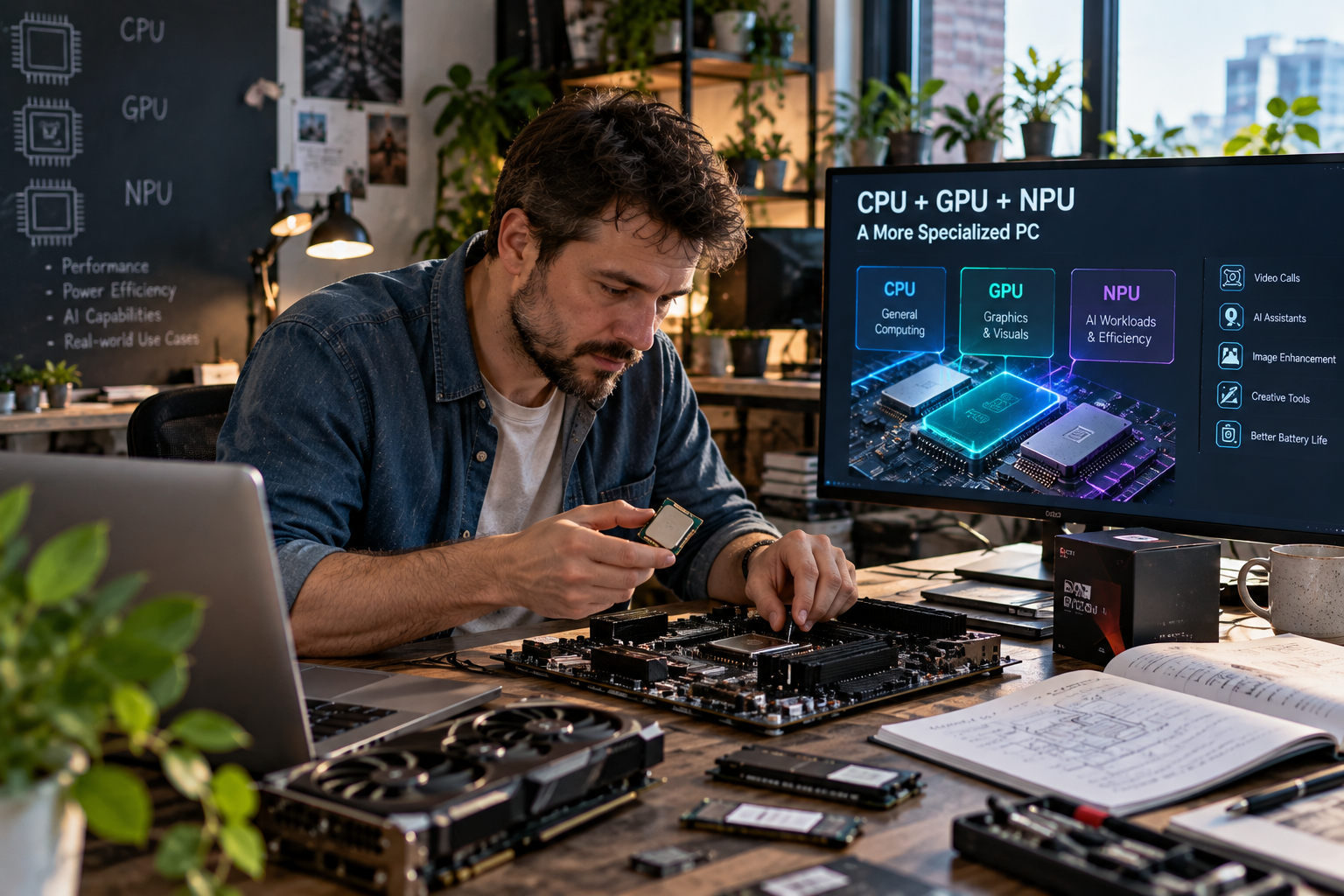
The CPU remains the general-purpose coordinator. The GPU handles highly parallel workloads and graphics. The NPU takes responsibility for certain AI operations that benefit from specialised acceleration.
The computer becomes more efficient when the workload is assigned intelligently.
Software Has to Learn How to Use the New Architecture
The hardware transition would be much less meaningful if software continued to treat the CPU as the only important processor.
Operating systems, applications and development frameworks increasingly need to understand heterogeneous computing. They have to decide whether a workload belongs on the CPU, GPU or NPU, and they need to move data between those components without creating excessive overhead.
This is one of the reasons hardware manufacturers are investing heavily in developer tools and software ecosystems.
Intel’s OpenVINO toolkit, for example, is designed to optimise and deploy AI models across Intel CPUs, GPUs and NPUs. AMD provides Ryzen AI software tools for developers working with AI applications on its processors, while Qualcomm provides its own AI software stack for applications targeting Snapdragon platforms.
The importance of this software layer cannot be overstated.
A powerful NPU is not particularly useful if applications cannot take advantage of it efficiently. Hardware specifications can attract attention, but the actual value appears only when developers integrate those capabilities into software people use every day.
Local AI Is Changing the Design of Laptops
The arrival of dedicated AI hardware is also changing laptop design itself.
If more processing can happen locally, manufacturers can build systems around workloads that previously depended more heavily on cloud services. That can reduce latency and, in some cases, improve privacy because certain operations do not need to leave the device.
The hardware implications are significant.
A laptop increasingly needs to provide enough memory, storage and processing capability to support local AI alongside conventional applications. That means manufacturers have to balance larger memory configurations and faster processors against the need to maintain battery life and keep thermal output under control.
The ideal AI laptop is therefore not simply a more powerful laptop.
It is a more carefully balanced one.
That distinction is important because it explains why modern processor development is moving toward heterogeneous designs rather than simply adding more general-purpose CPU performance.
Qualcomm Has Made Efficiency a Central Part of the Competition
The emergence of Arm-based Windows PCs has made this competition particularly visible.
Qualcomm’s Snapdragon X family entered the PC market with an emphasis on performance per watt, integrated connectivity and dedicated AI processing. The company has positioned the platform as suitable for thin-and-light systems that can deliver long battery life while supporting demanding workloads.
The significance of this approach extends beyond Qualcomm itself.
Intel and AMD now have to compete not only on conventional x86 performance but also on efficiency and the ability to deliver strong performance inside increasingly thin portable systems.
This is changing consumer expectations.
A laptop that needs to be connected to a charger throughout the day is increasingly difficult to market as a premium mobile computer. Users expect high performance without accepting the thermal and battery penalties that once accompanied it.
Intel and AMD Are Responding With Their Own Hybrid Strategies
The response from the established x86 manufacturers has been significant.
Intel’s Core Ultra architecture integrates CPU, GPU and NPU resources into the same processor platform, while AMD’s Ryzen AI architecture combines Zen CPU cores, Radeon graphics and XDNA AI acceleration.
These designs reflect an important change in processor development.
Rather than trying to make every part of the chip equally good at every task, manufacturers are increasingly creating specialised units and allowing software to determine how they should work together.
This can improve efficiency because a specialised unit does not need to consume the same amount of power as a general-purpose processor performing the same operation.
The trade-off is complexity.
More specialised hardware means that software developers have more opportunities to optimise their applications, but it also means that they have more architectures and APIs to consider.
Hardware Marketing Is Becoming Harder to Understand
There is a downside for consumers.
The old language of hardware was relatively simple. A processor had a certain number of cores and a certain clock speed. A graphics card had a certain amount of memory. A laptop had a particular battery capacity.
Today, a buyer may encounter CPU performance, GPU performance, NPU TOPS, memory bandwidth, AI acceleration, power limits and different forms of software optimisation.
Those numbers cannot always be compared directly.
A processor with a higher NPU rating is not automatically faster in every AI application. A chip with more CPU cores may not deliver better battery life. A powerful integrated GPU may be sufficient for one user but inadequate for another.
Consumers therefore need to look beyond individual specifications.
The question is increasingly whether the architecture is appropriate for the way the computer will actually be used.
Gaming and Creative Work Still Demand Conventional Power
The rise of specialised hardware does not make traditional performance irrelevant.
Gamers still need powerful GPUs. Video editors still benefit from fast processors, large amounts of memory and high-speed storage. Developers compiling large projects may care far more about sustained CPU performance than NPU capability.
This is why the modern PC cannot be reduced to an AI machine.
The NPU is another component in the architecture, not a replacement for the CPU or GPU.
A high-end gaming desktop may have little practical reason to rely heavily on its NPU today, while a thin productivity laptop may benefit significantly from one. The ideal hardware configuration depends on the workload.
This is one reason the market is fragmenting.
Instead of one definition of the best processor, manufacturers are increasingly building chips for different combinations of tasks.
The Future PC Will Be a Team of Processors
The direction of travel is becoming increasingly clear.
The future personal computer is unlikely to depend on one processor doing everything. Instead, different components will increasingly cooperate behind the scenes, with the operating system and applications deciding which part of the machine should perform a particular task.
The CPU will remain essential because general-purpose computing is not disappearing. GPUs will remain crucial for gaming, visualisation and highly parallel workloads. NPUs will become increasingly important as local AI features move from specialised demonstrations into ordinary software.
The real innovation will come from making these components work together efficiently.
That may sound less dramatic than simply announcing a processor that is twice as fast as the previous generation, but it could have a much greater effect on everyday computing.
A laptop that can intelligently move workloads between its CPU, GPU and NPU may feel faster even when no individual component represents a revolutionary leap in raw performance.
The Hardware Race Is Becoming a Race for Efficiency
The most important hardware trend of 2026 may therefore be a change in what manufacturers mean by progress.
Raw performance remains important, but it is no longer sufficient.
The strongest processors are becoming systems of specialised engines, each designed to handle particular categories of work. AI acceleration, integrated graphics and general-purpose computing now coexist inside increasingly sophisticated platforms, while software is learning to distribute workloads between them.
This architecture is likely to become more common rather than less.
As laptops become thinner, applications become more demanding and local AI becomes more widespread, manufacturers will have fewer opportunities to solve every problem simply by increasing power consumption.
The next generation of hardware will have to be smarter about where that power goes.
For consumers, that means the most interesting question when choosing a new computer may no longer be which processor is the fastest.
It may be which processor is the most efficient at doing the work that actually matters.