A game character can have a beautifully designed face, detailed clothing and an impressive environment around them, yet still feel strangely lifeless. The reason is often not the model itself. It is movement.
Players notice when a character turns too sharply, stops unnaturally, repeats the same gesture too often or appears disconnected from the ground. They may never describe the technical problem, but they feel it immediately. Animation is therefore one of the hidden foundations of believable game worlds.
For years, producing high-quality character animation required a combination of specialist animators, motion-capture equipment, external software and substantial amounts of manual cleanup. Modern game development is changing that workflow. Real-time animation systems, increasingly accessible performance capture, sophisticated rigging tools and animation retargeting are allowing developers to move from captured or authored motion to playable characters more quickly.
The result is not simply better-looking movement. It is a different way of thinking about how characters are created, tested and brought into a game.
Animation Is Becoming Part of the Game Engine
Character animation was once commonly treated as a production stage that happened largely outside the game itself. Animators created sequences, exported them and then integrated those assets into the engine.
Modern engines increasingly blur that separation.
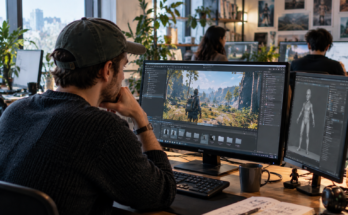
Unreal Engine, for example, provides a broad animation toolset inside the engine, including skeletal animation, Animation Blueprints, Control Rig and Sequencer. These tools can be used to create runtime animation systems as well as cinematic content directly inside the development environment.
Unity follows a similar philosophy. Its current animation system combines animation import, editing tools, real-time state machines and humanoid retargeting, allowing developers to move between imported content and in-engine animation workflows without treating them as completely separate worlds.
That matters because modern games rarely rely on one fixed animation. A character might walk, accelerate, turn, climb, react to an impact, aim at a target and interact with an object within the same minute. The animation system has to decide how these movements connect.
The challenge is no longer simply creating a convincing walk cycle. It is creating a system that can assemble convincing movement while the player is doing something unpredictable.
Motion Capture Is Moving Closer to the Creator
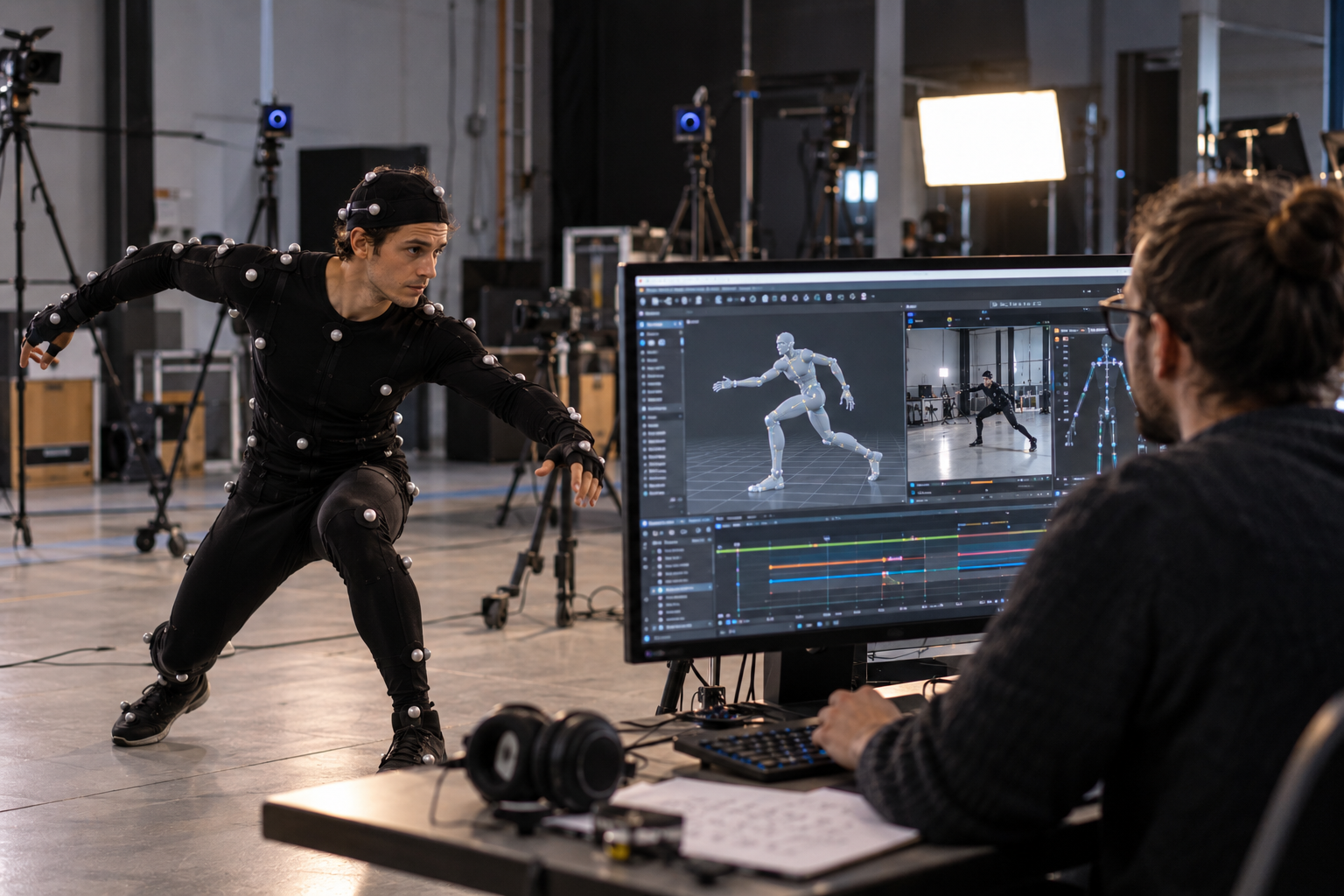
Motion capture has long been associated with expensive production environments, specialised studios and carefully controlled filming sessions. It remains an important part of high-end game development, but the technology is becoming more accessible.
Unreal Engine’s current MetaHuman Animator tools demonstrate how quickly this area is evolving. Epic’s documentation describes workflows that can generate animation from facial and body performances captured through video and audio devices, with both real-time and offline options.
The newer MetaHuman 5.8 release goes further. Epic has introduced an experimental capability for capturing body animation from a single camera, extending a workflow that previously focused more heavily on facial performance. The system is designed to work with consumer-oriented devices such as supported smartphones and webcams.
This does not mean professional motion-capture studios are becoming obsolete. High-end productions still have reasons to use specialised equipment, trained performers and controlled environments. What is changing is the barrier to entry.
A smaller team can increasingly record a performance, process it and see the result inside the engine without building an enormous capture pipeline. That makes experimentation easier. Developers can test an idea before committing to a large production session.
For independent teams, that can be particularly important. Animation is expensive to create when every movement has to be authored from scratch. More accessible capture tools can turn animation from a bottleneck into a faster iteration process.
The Hard Part Is Still Making Movement Feel Right
Technology can capture movement. It cannot automatically guarantee that the movement belongs in the game.
A captured performance might look natural in isolation but feel wrong when attached to a particular character. A movement designed for one body type may not translate perfectly to another. A dramatic real-world action may also be too slow, too subtle or too physically constrained for an interactive experience.
This is where rigging, retargeting and animation editing become essential.
Modern animation pipelines allow developers to transfer movement between compatible characters and adjust it to different rigs. Unreal’s animation documentation, for example, includes IK Rig, custom IK retargeting and runtime retargeting as parts of its character-animation workflow.
The practical significance is considerable. A developer does not necessarily need to recreate an animation every time a character changes.
Instead, a movement can become reusable material.
That changes the economics of animation production. A single performance can potentially become the foundation for several characters, while artists concentrate their time on the adjustments that make each character distinctive.
Retargeting Turns Animation Into a Reusable Asset
The importance of retargeting becomes clearer when looking at the sheer variety of characters in modern games.
A humanoid animation may need to work on characters with different proportions, heights and visual designs. If every character requires a completely separate animation library, production becomes increasingly difficult to manage.
Retargeting provides a bridge between those assets.
The technology does not remove the need for artistic supervision. In fact, the opposite can be true. Small differences in proportions can affect foot placement, posture, hand position and balance. A technically successful transfer may still require considerable refinement.
But the basic principle is powerful: animation can be treated less like a one-use recording and more like a reusable piece of production infrastructure.
This approach also supports faster prototyping. Developers can test how a new character feels before an enormous amount of bespoke animation work has been completed.
That is especially valuable during early development, when many ideas are eventually discarded.
Real-Time Animation Changes the Feedback Loop
One of the most important changes in modern animation is the shrinking distance between performance and result.
Epic’s current MetaHuman tools support real-time animation from sources including mono cameras, supported mobile devices and audio. The system can use Live Link to drive a character directly in the Unreal environment.
This creates a very different creative feedback loop.
Instead of recording an actor, processing the footage, exporting the animation and waiting until a later stage to see how it behaves in the game, developers can increasingly preview the relationship between performance and character immediately.
That makes animation more interactive.
A designer can see whether a facial performance works with a camera angle. A technical artist can identify problems with a rig. A director can experiment with timing. A programmer can test how an animation behaves alongside gameplay logic.
The boundary between animation production and gameplay development becomes less rigid.
Characters Need to Respond, Not Just Perform
The most convincing game characters are not simply playing pre-recorded movements. They are responding to the world.
A character walking across a flat studio floor can use a beautifully authored animation. A character moving across uneven terrain needs something more. Their feet need to adapt to the surface. Their body may need to adjust to slopes. Their posture can change according to movement speed or direction.
This is where procedural systems, inverse kinematics and animation logic become increasingly important.
The underlying animation may still be authored by an animator or captured from a performer, but the game can modify it according to circumstances.
The result is a hybrid approach. Human-authored animation provides style and intention, while runtime systems provide adaptation.
That balance is one of the defining characteristics of modern game animation.
Motion Matching Is Changing How Movement Is Selected
Another significant development is the growing use of systems that select appropriate movement from large animation libraries rather than relying exclusively on traditional state transitions.
Unreal Engine’s Game Animation Sample Project is designed to demonstrate a high-fidelity character animation system using Motion Matching. Epic describes the sample as a way to explore motion-capture animations and the technology used to select movement for a character.
The underlying idea is relatively simple but powerful. Instead of manually defining every possible transition between idle, walking, running and turning states, the system can evaluate available motion and choose an appropriate sequence based on the character’s current situation.
For players, the benefit can be subtle. Movement may feel less mechanical because transitions are better matched to what the character is actually doing.
For developers, however, the implications are larger. It represents a move toward animation systems that can make more decisions at runtime.
Animation Designers Are Becoming Systems Designers
As animation technology becomes more sophisticated, the role of the animator is changing.
The traditional craft of posing characters, refining timing and creating expressive performances remains essential. But modern animators increasingly need to understand how their work behaves inside a larger technical system.
They may need to consider how an animation blends with another clip, how it responds to player input, how it interacts with physics, how it behaves on different character rigs or how it performs when viewed from different distances.
This does not make animation less artistic.
It makes the discipline more connected to game design.
A beautifully animated movement that cannot respond properly to gameplay may be less useful than a slightly simpler animation that works naturally across dozens of situations. The best modern animation pipelines therefore combine artistic quality with technical flexibility.
Unity and Unreal Are Making Animation More Accessible
The direction is visible across the major game-development ecosystems.
Unity’s animation tools continue to support state-based character systems, animation blending and humanoid retargeting, while newer releases have also continued to integrate animation-related functionality more deeply into the editor. Unity 6.6, for example, makes Animation Rigging a core package and also moves Timeline into the core package structure.
Unreal Engine is pushing in parallel with skeletal animation, Control Rig, Sequencer, IK systems, Motion Matching examples and increasingly accessible performance capture.
The significance is not that one engine has solved animation.
Rather, animation is becoming a more integrated part of the development environment.
Artists can experiment closer to the final game. Technical teams can build animation systems without constantly moving between disconnected applications. Designers can evaluate movement while gameplay is still being developed.
That reduces friction across the entire production process.
The Future of Character Animation Will Be Hybrid
The next generation of game animation is unlikely to replace artists with a single automated technology.
Instead, it is moving toward hybrid production.
Performers provide human movement. Animators refine it. Rigging systems make characters adaptable. Retargeting makes motion reusable. Runtime systems respond to gameplay. Procedural tools handle variations. The engine brings these elements together in real time.
Even highly advanced capture technology still benefits from artistic judgment. Epic’s own documentation describes workflows that include animation review, refinement and export rather than treating generated motion as a finished product.
That distinction matters.
Games are interactive, and interaction creates situations that cannot all be predicted in advance. The goal is therefore not to record every possible movement. It is to build animation systems capable of producing convincing responses from a manageable collection of high-quality material.
This is why the future of game animation is less about creating more individual clips and more about creating better relationships between them.
Movement May Become One of the Biggest Competitive Advantages
Graphics are often the first thing players notice in a modern game, but animation determines whether those graphics feel alive.
A highly detailed character with stiff movement can break immersion instantly. A simpler character with excellent timing, responsive posture and convincing interaction with the environment can feel remarkably believable.
As development tools become more capable, animation is moving closer to the centre of game design. Real-time capture lowers production barriers. Retargeting increases reuse. Rigging systems create flexibility. Motion matching and runtime logic help characters respond to unpredictable player behaviour.
The result is a new production philosophy in which animation is no longer simply something added to a finished character.
It is part of how that character becomes a believable participant in the game world.
And as engines continue bringing capture, rigging, editing and runtime systems into the same environment, the most interesting developments may come not from any single animation technology, but from the way these technologies work together.