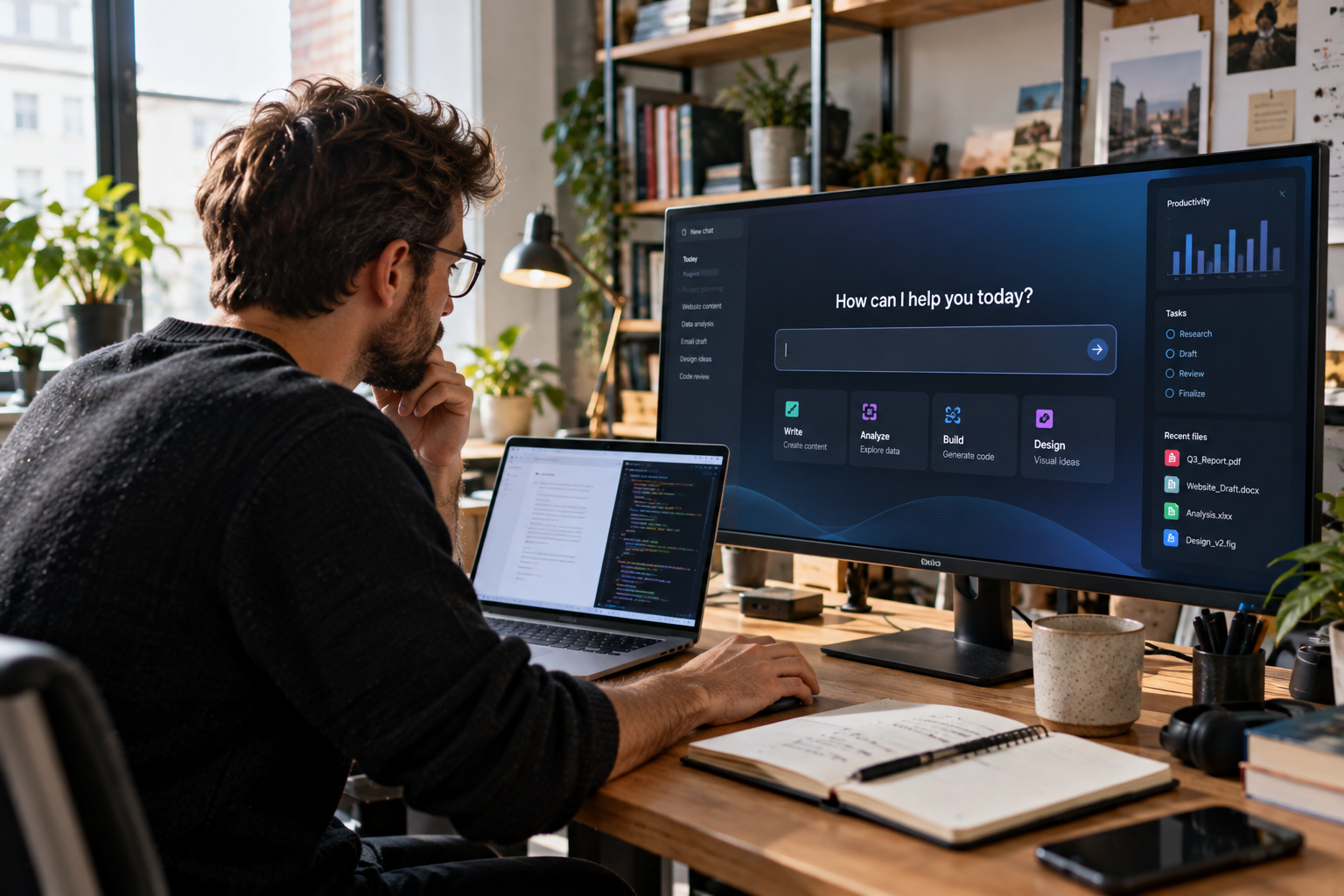
For decades, software has worked according to a relatively simple principle: people tell applications what to do, and the applications execute those instructions. A spreadsheet calculates numbers, an editor formats text, a database stores information and a project-management system organizes tasks.
Artificial intelligence is beginning to change that relationship.
Instead of requiring users to understand exactly which commands to enter, modern software can increasingly interpret natural language, identify patterns, generate content and carry out sequences of actions. The result is a shift from software as a collection of tools toward software as an environment that can participate in the work itself.
This transformation is happening across writing, programming, design, research, customer service, data analysis and everyday administration. AI is not replacing the underlying software in these areas. It is becoming a new layer through which people interact with it.
The significance of that change extends beyond convenience. It could alter what people need to know about software, how companies organize work and where the boundary between human decisions and automated execution is drawn.
Software Is Becoming Easier to Talk to
Traditional software often requires users to learn its interface before they can use it efficiently.
A new employee may need to understand menus, commands, shortcuts, file structures and specialized workflows. Professional applications can take months or even years to master because their capabilities are hidden behind increasingly complex interfaces.
AI introduces another way of interacting with these systems: conversation.
Instead of knowing exactly where a function is located, a user can describe the desired result. A person working with a large dataset might ask software to identify unusual patterns. A writer can request a restructuring of a document. A developer can explain the behaviour of a feature and ask for an implementation.
Natural-language interfaces do not eliminate the need to understand the underlying task. They reduce the amount of interface knowledge required to begin performing it.
That distinction is important. Software is becoming more accessible, but users still need to judge whether the result is correct.
The New Software User Is Part Operator, Part Editor
Generative AI can produce text, code, images, summaries and other forms of content at remarkable speed. But speed does not automatically produce quality.
The role of the user is therefore changing.
Instead of manually producing every element from the beginning, people increasingly describe goals, review generated results, identify errors and refine the output. The process resembles editing more than traditional command-based software use.
This creates a new kind of digital literacy.
Knowing how to use AI effectively involves understanding what a system can and cannot do, providing useful context, recognizing unreliable output and deciding when human verification is necessary. A fluent response can still contain incorrect information, faulty reasoning or unsuitable assumptions.
The strongest users will therefore not necessarily be those who can write the longest prompts. They will be those who can define a problem clearly and evaluate the result critically.
AI Is Moving From Generation to Action
The first wave of generative AI software largely focused on producing content. A user asked a question and received an answer, requested an image and received an image, or described a programming task and received code.
The next stage is more operational.
AI systems are increasingly being designed to work through multi-step processes: gathering information, manipulating documents, interacting with software, analyzing results and producing a completed output. This moves AI closer to an active participant in a workflow.
The difference between generating an answer and completing a task is substantial.
If software can interpret an objective, decide which tools are required and execute several connected actions, users may no longer need to operate every application individually. Instead, they could describe the outcome they want while AI handles more of the intermediate steps.
That could fundamentally change how digital work is organized.
The Application May Matter Less Than the Workflow
For years, software companies competed partly through features. A word processor needed better formatting, a design application needed more powerful editing tools and business platforms competed through increasingly sophisticated dashboards.
AI could shift some of that competition toward workflows.
Users may care less about which individual application performs a particular operation and more about whether a software environment can complete a task from beginning to end.
Imagine a business employee preparing a report. Instead of opening several applications to retrieve data, clean a spreadsheet, create charts, write an explanation and prepare a presentation, an AI-enabled workspace could coordinate those steps through a single request.
The individual applications might still exist underneath. What changes is the interface connecting them.
Software could increasingly become less about navigating between tools and more about describing an objective.
Programming Is Becoming a Different Kind of Software Skill
Few areas demonstrate this transformation more clearly than software development.
AI coding systems can generate functions, explain unfamiliar code, suggest fixes, create tests and help developers navigate large codebases. This does not make programming irrelevant. It changes where human expertise is applied.
Developers may spend less time writing routine code line by line and more time defining system architecture, evaluating generated code, understanding dependencies and deciding how software should behave.
The ability to verify AI-generated code becomes particularly important because software errors can remain hidden until they produce serious consequences.
This means that AI-assisted programming could lower the barrier to creating software while simultaneously increasing the value of deeper technical understanding. More people may be able to produce working prototypes, but reliable production systems will still require engineering judgement.
The difference between generating code and building dependable software remains significant.
Data Analysis Is Moving Toward Questions Instead of Commands
Data software is undergoing a similar transformation.
Traditional analytics often requires users to understand specific query languages, statistical tools or visualization systems. AI can increasingly translate natural-language questions into analytical operations.
A manager might ask which products experienced the largest change in demand. An analyst could ask the system to identify unusual patterns or compare several periods. The software can then help generate calculations and visualizations.
This makes data more accessible to people who are not specialists.
But accessibility introduces another responsibility. Users must understand where the data came from, whether the question was formulated correctly and whether the resulting interpretation makes sense.
A simple interface can hide complex assumptions. AI can make analysis easier to request without making the underlying evidence less important.
Personalization Is Becoming a Core Software Feature
Traditional software generally gives users the same underlying system with a collection of configurable settings.
AI makes deeper personalization possible.
A software environment can potentially learn how a user prefers information to be organized, what kinds of tasks they perform repeatedly and which actions are most useful in a particular context. Instead of manually configuring every aspect of the experience, the system can adapt.
This could make software feel less like a standardized product and more like an individualized workspace.
There is a trade-off, however. Greater personalization requires more information about the user, their behaviour and their work. That raises questions about privacy, data ownership and how much autonomy users are willing to give software.
The more software knows, the more useful it may become. But the same principle makes governance increasingly important.
Businesses Are Redesigning Work Around AI
The effect of AI on software becomes more significant when organizations redesign processes rather than simply adding an AI button to existing products.
A company may use AI to summarize customer interactions, analyze documents, assist employees with internal knowledge or automate repetitive administrative work. The largest productivity gains may come when several of these capabilities are connected into a single workflow.
This can change organizational structures as well.
When routine tasks become faster, employees may spend more time on decisions, communication, creative work and exception handling. Some roles may become broader because individuals can manage processes that previously required several specialized tools or teams.
At the same time, organizations have to decide which tasks should remain under direct human control.
Automation is most valuable when the cost of an error is understood and manageable. In areas involving sensitive information, financial decisions, legal consequences or important personal outcomes, speed cannot be the only measure of success.
The Interface Is Becoming Invisible
The most profound change may be happening at the level of interface design.
For decades, graphical user interfaces made computing more accessible by replacing command lines with windows, icons, menus and buttons. AI introduces another abstraction: intention.
Instead of telling software which sequence of buttons to press, the user describes what should happen.
This does not mean graphical interfaces will disappear. People will still need ways to inspect results, correct mistakes and control automated processes. But the interface may increasingly become adaptive, conversational and context-aware.
The computer becomes less like a machine that waits for instructions and more like a system that interprets goals.
That is a major shift in the history of software.
The Hardest Problem Is Knowing When Not to Automate
The rapid development of AI can create the impression that every software process should eventually become autonomous. That assumption is unlikely to hold.
Some tasks benefit enormously from automation because they are repetitive, predictable and easy to verify. Others depend on context, responsibility, empathy or consequences that cannot be reduced to a simple success metric.
Human judgement remains especially important when the cost of an incorrect decision is high.
The future of AI software will therefore not be defined only by what machines can do. It will also depend on how carefully people decide what machines should do.
That distinction could become one of the most important software-design principles of the coming decade.
A New Definition of Digital Literacy
As AI becomes embedded in ordinary software, knowing how to operate a particular application may become less important than understanding how to work with intelligent systems.
Users will need to formulate goals, provide context, inspect results, identify uncertainty and intervene when automation goes wrong. They will also need to understand permissions, privacy and the boundaries of systems that can increasingly act on their behalf.
This is a broader skill than learning a particular program.
The shift could ultimately make technology more accessible while raising the value of critical thinking. People may need fewer technical instructions to accomplish a task, but they may need stronger judgement to decide whether the task was accomplished correctly.
That is the central paradox of intelligent software.
AI can make computers easier to use, but it does not make decisions less important.
Software Is Moving Toward Intent
The long-term direction of AI and software is becoming increasingly clear. Applications are moving away from being passive tools that wait for precise instructions and toward systems that can interpret goals, generate solutions and coordinate actions.
For users, that could mean less time spent navigating interfaces and more time defining what they actually want to accomplish.
For businesses, it could mean redesigning workflows around outcomes rather than individual applications. For developers, it could shift attention from writing every line of code toward architecture, verification and system design.
The technology is still evolving, and many of the most ambitious promises remain experimental. But the underlying change is already significant.
Software has spent decades learning how to execute instructions. The next stage is teaching it to understand intent.
The most successful systems may be those that make this transition without taking control away from the people who use them.