The first generation of widely used AI software was largely conversational. People asked questions, requested summaries, generated text or sought help with a particular problem. The interaction was familiar: the user made a request, the system produced an answer and the user decided what to do next.
A new generation of AI software is moving beyond that model.
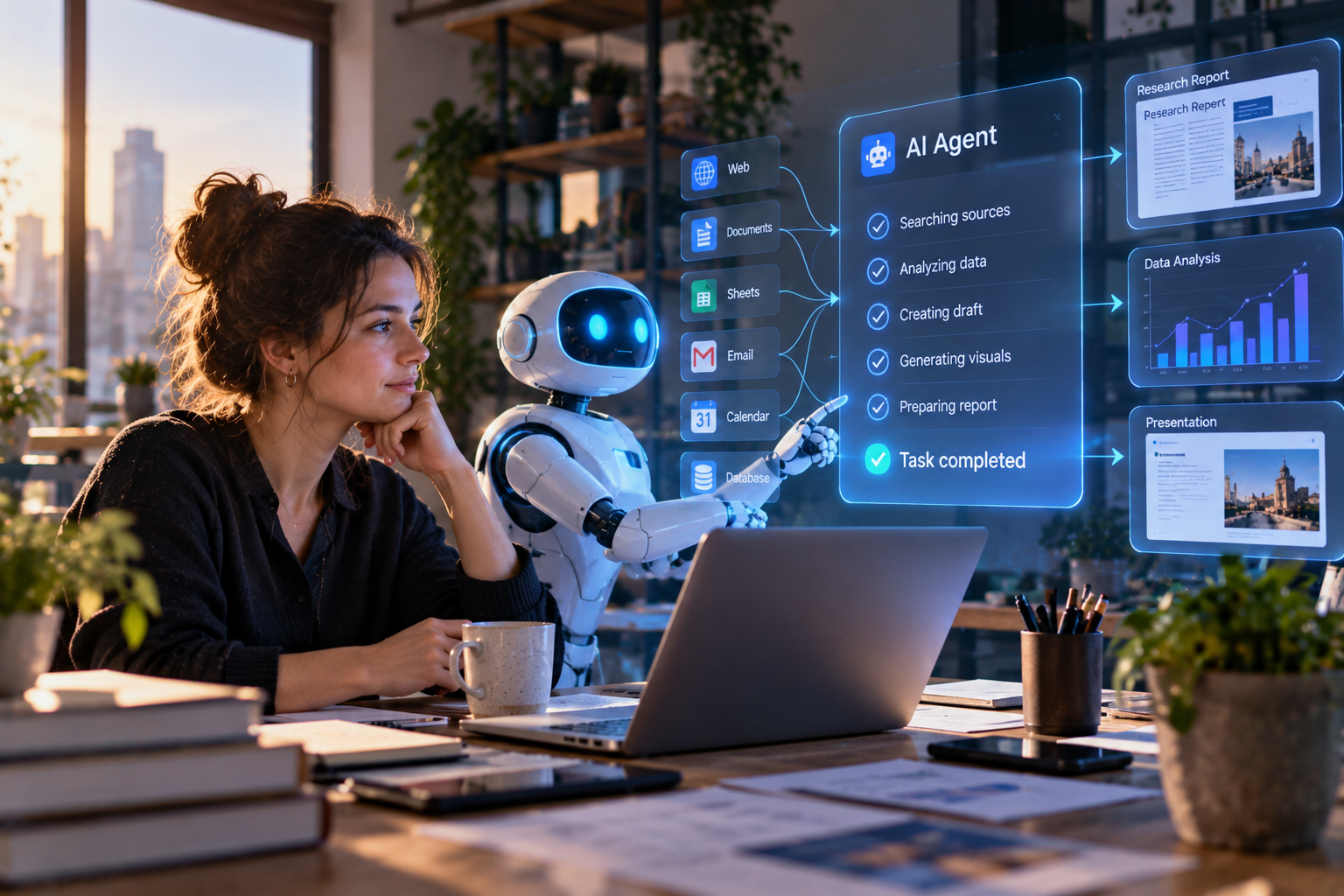
AI agents are being designed to handle sequences of actions rather than simply generate individual responses. They can potentially interpret an objective, decide which steps are required, use software tools, inspect intermediate results and continue until a task has been completed.
That changes the role of AI inside software.
A chatbot primarily responds. An agent can act.
The distinction is becoming increasingly important as companies experiment with AI for research, customer support, coding, data analysis, administration and other knowledge-intensive work. Instead of adding AI as another feature inside an application, developers are beginning to build systems around the idea that software can perform parts of a workflow independently.
From Answers to Completed Tasks
A conventional AI assistant might help an employee write an email or summarize a document. The person remains responsible for opening the relevant applications, copying information between systems and completing the remaining steps.
An agent-oriented system approaches the same problem differently.
The user can provide an objective rather than a detailed sequence of instructions. The software may then break the objective into smaller actions, use available tools and adjust its approach when circumstances change.
For example, a research workflow could involve locating relevant documents, extracting information, comparing findings and preparing a draft. The important development is not that AI can generate each individual piece. It is that the system can potentially connect those pieces into one process.
This moves software closer to task completion.
The user still defines the goal and evaluates the outcome, but fewer intermediate operations need to be performed manually.
Why Agents Need Access to Other Software
An AI model on its own is limited by what it can see and what it can produce. To perform useful tasks in the real world, an agent needs access to tools.
That might include a web browser, a spreadsheet, a database, a coding environment, a calendar, an internal company knowledge base or another software application.
This tool access is what separates an agent from a conventional conversational system.
Instead of merely explaining how to perform an action, an agent can potentially perform the action itself. It could retrieve information from a system, process that information and pass the result into another application.
The software therefore becomes an interconnected environment rather than a collection of isolated programs.
This is one reason AI agents are attracting attention from enterprise software developers. Many business processes already involve moving information between several systems. Automating those transitions can be more valuable than simply generating another piece of content.
The End of the Single-Application Workflow
Modern office work often requires employees to move constantly between applications.
A typical process might involve email, documents, spreadsheets, databases, messaging platforms and project-management software. The individual programs may work perfectly well, yet the employee becomes the connection between them.
AI agents could change that arrangement.
Rather than asking users to manually coordinate every system, an agent can potentially serve as an orchestration layer. It can interpret a request, determine which applications are relevant and move information between them.
This does not mean that individual applications will disappear. Specialized software will remain necessary because organizations still need databases, financial systems, design tools and communication platforms.
What could change is the way people interact with those systems.
The user may increasingly communicate with an intelligent layer that coordinates the applications underneath.
Reliability Becomes More Important as Autonomy Increases
The more independently software can act, the more important reliability becomes.
A mistake in a generated paragraph may be inconvenient. A mistake made by an autonomous system while modifying a database, sending messages or changing a business record can have much greater consequences.
This creates a fundamental difference between generative AI and agentic software.
When a system only produces information, the user can inspect it before acting. When the system can take action itself, the boundary between suggestion and execution becomes much thinner.
Developers therefore need mechanisms for permissions, verification, monitoring and human intervention. An agent should not necessarily have unlimited access simply because it technically can perform a particular action.
The question becomes not only whether an AI system can complete a task, but under what conditions it should be allowed to do so.
Human Oversight Is Becoming a Software Feature
Traditional applications generally assume that the user is responsible for initiating actions. Agentic systems reverse part of that relationship.
The software may initiate intermediate actions itself, which means users need new ways to supervise it.
This could involve approval steps before sensitive operations, activity logs showing what an agent has done, clear explanations of important decisions and mechanisms for stopping an ongoing process.
Such features are not merely administrative additions. They are part of the user interface for autonomous software.
A useful agent needs to be capable enough to reduce manual work but predictable enough that people remain confident about what it is doing.
The balance between those two requirements will shape the design of future AI applications.
Coding Is Becoming an Early Testing Ground
Software development is one of the clearest areas in which agentic systems can demonstrate their potential.
An AI system can already help generate code, explain errors and suggest solutions. Agent-oriented development environments take the idea further by allowing systems to inspect repositories, modify files, run tests and respond to the results.
Instead of generating a function and stopping, the system can work through a larger development task.
This approach can reduce the amount of routine implementation developers have to perform manually. It can also allow software teams to experiment with ideas more quickly.
But autonomous coding creates the same verification problem found elsewhere. Generated code can introduce security vulnerabilities, incorrect assumptions or subtle compatibility issues.
The developer’s role therefore shifts toward architecture, review, testing and judgment rather than disappearing.
Agents Could Change How Businesses Organize Expertise
If AI agents become reliable enough to perform substantial portions of knowledge work, their impact could extend beyond individual productivity.
Businesses may begin redesigning roles around the tasks that humans perform best and the tasks that software can perform efficiently.
An employee might supervise several automated workflows instead of manually completing every step. A customer-service specialist could focus on unusual cases while agents handle routine requests. Analysts could spend more time interpreting results while software prepares data and performs preliminary analysis.
This could increase productivity, but it could also change the skills organizations value.
Understanding processes, evaluating results and managing automated systems may become more important than memorizing the mechanics of individual software applications.
In that sense, AI agents could contribute to a broader transition from software literacy toward workflow literacy.
The Security Problem Gets Bigger
Greater autonomy also creates greater security risks.
An agent with access to multiple systems potentially has more opportunities to encounter sensitive information, follow malicious instructions or make unintended changes. A compromised or poorly designed agent could therefore create problems across several connected applications rather than inside a single system.
Security researchers and developers are increasingly concerned about issues such as excessive permissions, prompt injection, data leakage and unsafe tool use.
The underlying principle is straightforward: an AI system should have only the access it needs for the task it has been authorized to perform.
This becomes particularly important when agents interact with external content. A document, webpage or message may contain instructions that were not intended to control the agent but could nevertheless influence its behaviour.
As AI becomes more capable of acting, cybersecurity has to account for software that can interpret language and make decisions, not just software that executes fixed commands.
The Agent May Become the New Software Interface
The long-term significance of AI agents may be less about individual autonomous tasks and more about how people interact with computers.
For decades, users have learned the structure of software. They know which application to open, where to find a particular feature and how information moves between systems.
An agent can potentially reverse that relationship.
The user describes an outcome, while the system determines which software and operations are required.
This resembles the evolution from command-line computing to graphical interfaces, except that the abstraction is now based on intent rather than visual controls.
The user does not necessarily need to know which application performs each step. The agent becomes the intermediary between the person’s objective and the underlying software infrastructure.
That could make complex technology substantially easier to access.
Not Every Task Should Become Autonomous
The growing enthusiasm around AI agents creates an obvious temptation: automate everything that can technically be automated.
That would be a mistake.
Some processes are repetitive and easy to verify. Others involve legal responsibility, sensitive personal information, financial consequences or decisions that require a deep understanding of human circumstances.
Autonomy should therefore be treated as a design choice rather than an automatic improvement.
A good AI system may sometimes recommend an action instead of taking it. In other cases, it may complete routine steps automatically but require human approval before crossing a certain threshold.
The most useful agent may not be the one that acts the most independently. It may be the one that understands when independence is appropriate and when human involvement is necessary.
The Next Generation of Software Will Be More Active
AI agents represent a significant shift in the history of software because they change the basic relationship between user and application.
Traditional software waits for instructions. Generative AI responds to requests. Agentic software aims to pursue objectives through multiple actions.
That progression could transform everyday digital work.
People may spend less time moving information between applications, repeating routine procedures and navigating complex interfaces. Instead, they may define goals, supervise automated workflows and focus on decisions that require human judgment.
The transition will not happen overnight, and many agentic systems are still developing. Reliability, security, accountability and integration remain substantial challenges.
But the direction is clear.
Software is becoming increasingly capable of doing more than showing information or generating content. It is beginning to operate.
The important question for the next stage of AI development is therefore not simply what computers can create. It is what they can responsibly accomplish on our behalf.