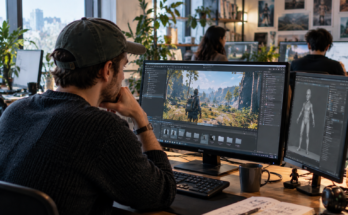
A convincing game world is not created simply by making a large map and filling it with objects.
Players rarely remember a virtual environment because it contains a particular number of buildings, trees or kilometres of terrain. They remember how a place made them feel, whether it encouraged exploration, how naturally its spaces connected and whether the environment seemed to have a purpose beyond providing scenery.
That makes level design one of the most demanding disciplines in game development.
Modern tools are changing how designers approach the problem. Large-world technologies can divide enormous environments into manageable streaming regions, while procedural content generation can help populate landscapes with vegetation, rocks, buildings and other environmental elements. Unreal Engine’s current PCG framework, for example, is designed to support workflows ranging from individual assets and biome generation to entire worlds, with both editor-time and runtime generation available.
Yet technology has not made level design automatic. In many ways, it has made the designer’s role more important.
When a development team can generate thousands of environmental elements quickly, the difficult question becomes deciding where those elements should exist, why they should be there and what they should make the player feel.
The modern game world is therefore becoming a collaboration between authored design and systems capable of producing complexity at scale.
A Large Map Is Not Necessarily a Large World
The industry’s fascination with open-world games has made map size an easy metric for ambition. Bigger maps can look impressive in promotional material, but physical scale alone does not create a compelling experience.
A large empty landscape can feel smaller than a compact environment filled with meaningful choices.
Level designers have to consider movement, visibility, pacing, landmarks, encounters and the relationship between different areas. A road needs a reason to exist. A building needs to communicate something about its surroundings. A mountain can be useful because it guides navigation, establishes a sense of distance or creates a visual destination.
The player may not consciously notice these decisions, but they determine how easily the world can be understood.
This is why level design is often less about placing objects than about controlling relationships between spaces.
The strongest environments guide players without making them feel controlled. They provide enough information to encourage curiosity while leaving enough uncertainty to make exploration rewarding.
World Partition Changes How Large Environments Are Managed
As virtual worlds become larger, developers face a practical problem: a computer cannot treat an enormous game environment as though every object needs to remain active at every moment.
Unreal Engine’s World Partition system addresses this by storing a large world in a persistent level and dividing it into grid cells that can be loaded or unloaded according to the player’s position and other streaming sources. Epic describes it as an automatic data-management and distance-based level-streaming system intended to simplify large-world development.
For players, the technical system is largely invisible.
They can move through a world without seeing the boundaries between the underlying data regions. For developers, however, the change is substantial because large environments can be managed as connected spaces while the engine handles much of the process of deciding what needs to be loaded.
This does not eliminate performance challenges. Developers still have to consider memory, asset complexity, rendering, collision, artificial intelligence and the amount of information active around the player.
What changes is the scale at which these problems can be organized.
A world can be designed as a continuous environment while being managed internally as a collection of smaller pieces.
Procedural Generation Is Becoming Part of the Designer’s Toolkit
Procedural generation is sometimes described as a way to make games without human designers. That description misses how the technology is actually being used in modern development.
The more useful approach is to think of procedural generation as a system for helping designers create variation.
A developer can define rules for where certain objects are allowed to appear, how densely they should be distributed and how their placement should respond to terrain or other environmental information. The system can then generate many results while preserving the constraints established by the designer.
Unreal Engine’s PCG framework is built around this kind of workflow. Its procedural graphs process spatial data, filter and modify generated points, and use those points to place assets or create other content. The framework can also operate at different scales and supports partitioned, hierarchical and runtime generation modes.
That distinction between rules and results is important.
A designer does not necessarily specify the exact position of every tree. Instead, the designer can establish the conditions under which trees should appear, the kinds of terrain they prefer and the visual density appropriate to different areas.
The result can contain thousands of individual decisions without requiring thousands of manual placements.
Procedural Does Not Mean Random
One of the most common misunderstandings about procedural generation is the idea that it simply produces randomness.
Good procedural design is usually much more constrained.
A forest generated by a game engine still needs to respect terrain, climate, paths, sightlines, gameplay requirements and performance limits. A city needs roads, buildings and public spaces that follow understandable relationships. A cave system needs passages that remain navigable and support the intended gameplay.
Pure randomness would quickly produce environments that feel incoherent.
Procedural systems become useful when they encode relationships.
The designer establishes rules, the system produces variations within those rules, and the team evaluates the results. If the outcome does not work, the rules can be changed and the environment regenerated.
This makes procedural generation particularly valuable during iteration.
Instead of manually replacing hundreds of objects, developers can adjust the underlying logic and regenerate the affected area.
The Best Worlds Combine Handcrafted and Generated Content
Modern development is increasingly moving away from the idea that a world must be either entirely handcrafted or entirely procedural.
The two approaches can complement each other.
A designer might manually create a major settlement, landmark or important gameplay space while using procedural systems to generate surrounding vegetation, rocks and environmental details. Another area might use procedural tools for its initial layout and then receive extensive manual editing.
This hybrid approach is particularly powerful because it combines scale with intentionality.
Procedural tools can handle repetition and variation, while human designers concentrate on places where specific decisions matter.
Epic’s current PCG documentation explicitly describes the framework as a way to integrate procedural workflows into existing world-building pipelines, blurring the distinction between procedural and traditional approaches.
The important word is integration.
Procedural generation is becoming part of normal production rather than a separate category of game design.
Cities Demonstrate the Potential of Systems-Based World Building
Urban environments are among the clearest examples of why procedural tools are becoming increasingly important.
A modern city can contain thousands of buildings, roads, signs, trees, vehicles and smaller environmental details. Manually placing every element would require enormous amounts of time, and even then the result could feel repetitive if the underlying relationships were not carefully designed.
Epic’s current Unreal Engine documentation includes a City Sample PCG workflow in which procedural graphs generate elements such as building structures, rooftops, park environments, forests and city-edge areas. The documentation also demonstrates how these generated elements can be partitioned for streaming in a World Partition environment.
The significance is not that an engine can automatically build a city.
It is that developers can describe systems that produce different components of a city while retaining control over the relationships between them.
That changes the nature of environmental production.
Instead of treating a city as an enormous collection of individual assets, developers can treat it as a system with rules.
Scale Creates New Problems
Larger worlds do not automatically make development easier.
In fact, scale can multiply problems.
Every additional region can require more assets, more navigation data, more lighting considerations, more gameplay testing and more memory management. A world that looks impressive from a distance can become difficult to maintain when every area needs to function correctly.
Procedural generation introduces another layer of complexity because generated content has to be debugged.
Epic’s PCG documentation specifically provides debugging tools for visualizing point data, inspecting nodes and identifying how generated information moves through a procedural graph.
This illustrates an important reality: automation creates its own development workload.
When a designer manually places an object, the result is easy to identify. When a system places thousands of objects according to a graph, developers need tools for understanding why the system produced a particular result.
The more powerful the generation system becomes, the more important observability becomes as well.
Performance Has to Be Designed Into the World
A beautiful environment is only useful if a game can run it effectively.
This is one reason large-world development increasingly involves streaming, partitioning and multiple levels of detail. World Partition can load only portions of a large environment around relevant streaming sources, while procedural systems can divide generated content into localized regions. Epic’s documentation describes partitioned and hierarchical PCG modes specifically as ways to manage generation across larger spaces and improve the handling of generated content.
These systems affect design decisions.
A developer cannot simply think about what an environment should look like. The team also has to consider how that environment will be stored, generated, streamed and rendered.
The technical structure of a world therefore becomes part of its design.
A forest is not only a collection of trees. It is also a set of assets that must be generated, organized and loaded efficiently.
A city is not only streets and buildings. It is a data structure that has to remain manageable while the player moves through it.
Interactivity Makes a World More Than Scenery
The next step beyond environmental detail is interaction.
A world feels substantially more convincing when its elements respond to the player or to one another. Doors open, objects can be moved, weather changes, characters react and spaces evolve according to gameplay.
This is where systems-based design becomes particularly important.
Instead of creating every possible state manually, developers can create rules that determine how the world responds under different circumstances.
The result can be more dynamic than a purely authored sequence because players may produce situations the developers did not explicitly script one by one.
However, systemic complexity needs boundaries. Too much unpredictability can make a game difficult to understand or test. The challenge is to create enough flexibility for players to feel that their actions matter without sacrificing clarity.
A convincing world is therefore not necessarily one in which everything is simulated.
It is one in which the right things respond at the right time.
Level Designers Are Becoming Systems Designers
These technological changes are gradually expanding the role of the level designer.
The profession once focused heavily on arranging spaces, encounters and environmental elements. Modern tools require designers to understand procedural rules, streaming, performance constraints and the relationship between authored content and generated systems.
That does not make the designer less creative.
It changes the level at which creativity operates.
Instead of deciding only where individual objects should be placed, designers can increasingly decide what rules should govern entire regions.
A designer might define how vegetation changes with altitude, how settlements grow around roads or how environmental details communicate a change in climate. The system then helps apply those decisions across a much larger space.
Creative control moves from individual placement toward the design of relationships.
The Future World Will Be Built in Layers
The direction of modern level design suggests that future game worlds will increasingly combine several layers of production.
At the foundation are large-scale systems that manage terrain, streaming and world structure. Above them are procedural systems that generate environmental variation. Human designers then shape important locations, gameplay spaces and visual landmarks. Finally, interactive systems give the environment behaviour and allow players to influence it.
Each layer solves a different problem.
Technology provides scale. Procedural generation provides variation. Human design provides intention. Interactive systems provide responsiveness.
None of these elements is sufficient by itself.
A procedurally generated world can be enormous but meaningless. A beautifully handcrafted environment can be memorable but expensive to produce at extreme scale. A highly interactive system can be impressive but confusing if the underlying spaces are poorly designed.
The strongest games combine these approaches carefully.
The Goal Is Not a Bigger World, but a More Convincing One
Game development technology is making it increasingly possible to build environments that would have been extremely difficult to manage a decade ago. Current Unreal Engine tools can generate content across large areas, divide worlds into streamable regions and support increasingly sophisticated procedural workflows.
But the technological achievement is only the beginning.
Players do not explore a world because its underlying systems are impressive. They explore because something in that world makes them curious. They remember a location because it communicated atmosphere, challenge, danger, beauty or discovery.
That is why the future of level design will not be determined simply by how much content developers can generate.
The more important question will be how intelligently they use that ability.
Modern tools can create forests, cities, landscapes and enormous spaces at a scale that would once have demanded extraordinary amounts of manual labour. The real craft lies in turning that scale into places that feel intentional.
The best game worlds may therefore be the ones where players never think about the technology producing them.They simply believe the world is there.